
The Cost of Downtime vs. Infrastructure
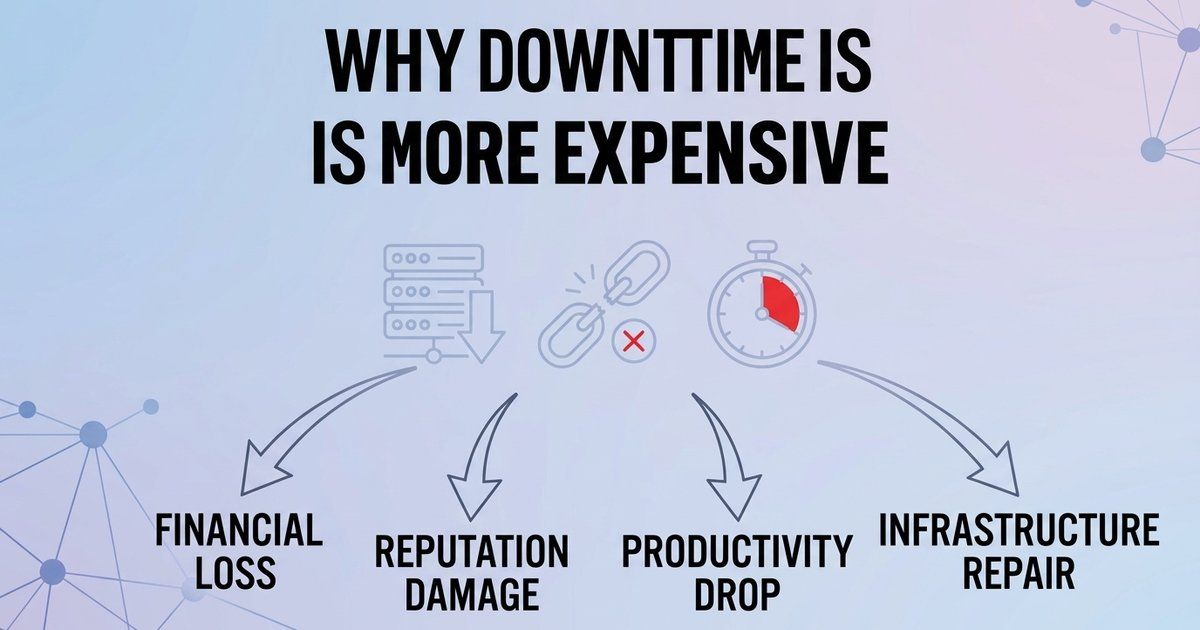

Why Downtime Is More Expensive Than the Infrastructure That Prevents It
For large enterprises, a single hour of system downtime can cost up to $700,000. The infrastructure investment that would have prevented it is almost always a fraction of that number — yet it's the one that gets questioned in the budget meeting, while the outage cost gets absorbed silently after the fact.
Want a clear-eyed comparison of what resilience investment would actually cost your organization?
Redundant infrastructure — duplicate systems, backup power, multi-region deployment — has a very specific problem in budget conversations: its cost is visible and immediate, while the cost it prevents is invisible and deferred. This asymmetry is exactly why resilience investment gets cut or delayed more often than it should, even when the underlying math clearly favors making the investment.
Stats That Matter
- Roughly 60% of system failures cost companies over $100,000 to repair, and for larger enterprises, a single hour of downtime can reach $700,000.
- Investment in disaster recovery infrastructure has been shown to pay for itself the first time it prevents or quickly resolves a single outage — a $500,000 annual investment is easily justified against a $100,000-per-hour revenue loss scenario.
- 70% of unplanned downtime traces back to poor redundancy planning — meaning most costly outages weren't unlucky, they were structurally set up to happen.
Why This Trade-Off Gets Evaluated Backwards
The natural instinct in a budget review is to compare the cost of redundant infrastructure against the cost of not having it in a "normal" year — a year with no major incident. Framed that way, redundancy always looks like an expense with no visible return, because the return only materializes during the specific event it was built to prevent. This is precisely the wrong comparison. The correct comparison is the infrastructure cost against the expected value of downtime risk — the cost of an outage multiplied by the realistic probability of it occurring, not against a hypothetical incident-free scenario.
Once framed this way, the calculation typically favors investment clearly: if a single hour of downtime costs $100,000 in lost revenue and an outage of that scale is even moderately likely over a multi-year horizon, an annual resilience investment well under that single-incident cost is straightforward insurance, not a discretionary expense.
Why "It Hasn't Happened Yet" Is the Wrong Signal
A dangerous pattern in leadership decision-making is treating the absence of a recent major incident as evidence that current infrastructure is adequate. This confuses "hasn't failed yet" with "won't fail." The vast majority of unplanned downtime traces back to poor redundancy planning identified well before the incident occurred — meaning the vulnerability existed and was often knowable in advance; it simply hadn't been triggered yet. An organization that hasn't had a major outage isn't necessarily well-protected — it may simply be early in a countdown that redundancy planning would have addressed.
Not All Redundancy Is Worth the Same Investment
This doesn't mean every system deserves maximum redundancy regardless of cost — that would simply move the waste from "too little protection" to "over-engineered protection nobody needed." The right approach matches the level of resilience investment to the actual business impact of that specific system failing: a low-frequency, low-impact system may not justify expensive redundancy, while a customer-facing revenue system with frequent, high-impact failure potential clearly justifies stronger investment in automation, monitoring, and architectural redundancy.
This is where a disciplined total cost of ownership comparison matters. Leadership should evaluate not just the sticker price of a redundancy solution, but its full ongoing cost — subscription fees, implementation labor, training, and operational maintenance — against the realistic downtime cost it's protecting against. A solution that looks cheap upfront but requires constant specialized care can end up costing more than the risk it mitigates, while a modestly priced solution that runs reliably in the background can be exactly the right fit for a lower-stakes system.
The Framework for Getting This Decision Right
Map business impact by system, not by infrastructure category. Not every server carries equal weight. Identifying which systems carry direct revenue linkage, compliance obligations, or high customer-facing exposure lets leadership direct resilience investment where the expected value of protection is actually highest, rather than spreading a fixed redundancy budget evenly.
Calculate downtime cost per system, not just company-wide. A company-wide "cost of downtime" number is too blunt to guide specific investment decisions. Knowing that your primary transaction system costs $50,000 per hour of downtime while an internal reporting tool costs a few hundred dollars an hour tells you exactly where redundancy investment earns its keep.
Treat resilience investment as insurance, priced against expected value, not against a no-incident baseline. The comparison that matters is investment cost versus (incident cost × realistic probability), not investment cost versus a hypothetical year where nothing goes wrong.
Why This Matters More as AI and Cloud Complexity Grow
This calculation is becoming more urgent, not less, as infrastructure grows more complex. High-density AI and GPU workloads introduce new points of failure and new cost structures, and the interconnected, multi-provider cloud environments covered elsewhere in this series create more places for a single point of failure to hide. The organizations treating resilience planning as a one-time setup rather than an ongoing discipline are the ones most likely to discover a gap in exactly the systems they assumed were covered.
What Leadership Should Ask Before the Next Infrastructure Budget Review
What would an hour of downtime cost for each of our top five revenue-generating systems, specifically? A precise number changes the conversation from "redundancy is expensive" to "this specific investment is cheap relative to this specific risk."
Do we know which of our systems currently have a single point of failure, and was that a deliberate risk decision or an oversight? A large share of costly outages trace back to redundancy gaps that were identifiable in advance — the question is whether anyone was looking.
Are we pricing resilience investment against total cost of ownership, or just the upfront sticker price? A solution that requires ongoing specialized maintenance can quietly cost more than a pricier but lower-maintenance alternative over its useful life.
Key Takeaways
- A single hour of enterprise downtime can cost up to $700,000, while the infrastructure investment that prevents it is typically a fraction of that, especially when priced against expected value rather than a no-incident baseline.
- The absence of a recent major outage is not evidence of adequate protection — most costly downtime traces back to redundancy gaps that existed and were identifiable in advance.
- Redundancy investment should be matched to the actual business impact of each system failing, not applied uniformly — over-engineering low-impact systems wastes the same budget that under-protects high-impact ones.
- Evaluate resilience solutions on total cost of ownership, not sticker price — hidden maintenance and operational costs can erase the apparent savings of a cheaper option.
- Growing infrastructure complexity from AI workloads and multi-cloud environments makes resilience planning an ongoing discipline, not a one-time setup.
What to Do Next
If your organization doesn't have a clear, per-system picture of downtime cost and redundancy coverage, that gap is exactly where the next expensive, preventable outage is most likely to originate.
I work with a trainer who specializes in exactly this: helping leadership and technical teams build the resilience planning discipline that turns infrastructure investment into a clear, defensible business decision. If this is on your radar for the next quarter, call or contact me and I'll help you get started.